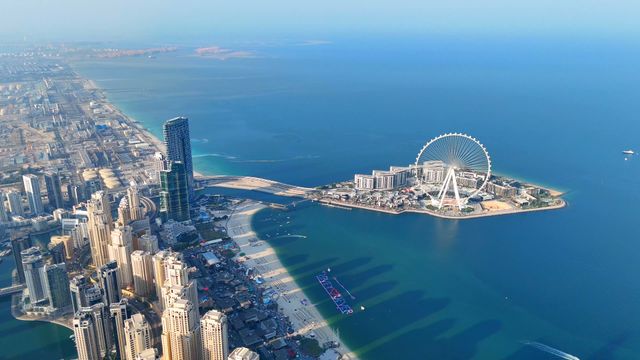
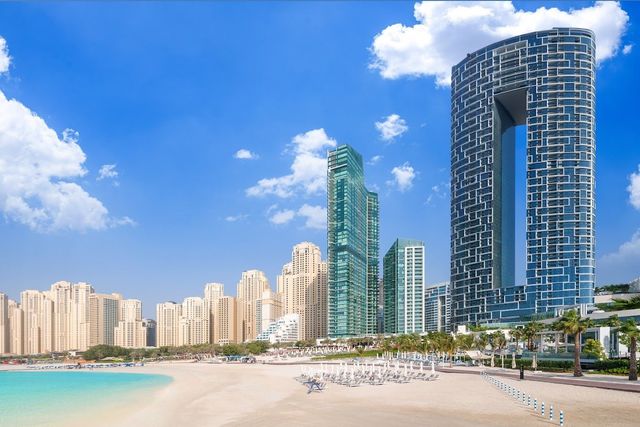
Dubai real estate broke its transaction volume record in 2023. Then broke it again in 2024. Then again in 2025, with 127,000 deals worth AED 760 billion. Prices in prime zones are 56–68% above 2020 levels. This is not a speculative bubble sustained by cheap credit — it is driven by seven structural factors that reinforce each other. Here they are, with the data behind each.
Dubai residential deals per year — sustained multi-year growth (thousands)
1. Population Growth — Structural Demand
Dubai’s population crossed 3.8 million in 2025 and is officially targeting 5.8 million by 2040 under the Dubai 2040 Urban Master Plan. That is 2 million additional people who will need housing, services, offices, and retail space over the next 15 years.
In 2024 alone, Dubai recorded a net population increase of approximately 200,000 people — more than the total population of Iceland. This was not temporary COVID rebound; it was the fourth consecutive year of net positive migration at this scale.
| Year | Dubai population (est.) | Net annual addition |
|---|---|---|
| 2020 | 3.3 million | — |
| 2021 | 3.41 million | +110,000 |
| 2022 | 3.51 million | +100,000 |
| 2023 | 3.62 million | +110,000 |
| 2024 | 3.80 million | +180,000 |
| 2025 (est.) | 3.97 million | +170,000 |
Each additional resident needs housing. If 50% of new arrivals buy (rather than rent), that is 85,000 new buyers per year on top of the existing resale market — before counting existing residents upgrading their homes.
2. Golden Visa — The Policy Inflection Point
The 2021–2022 Golden Visa reform was the single biggest demand catalyst in Dubai’s recent property history. Before: foreign buyers received a 2-year renewable residency tied to the property, which expired if they sold. After: buyers spending AED 2M or more receive a 10-year residency that is not tied to selling the property. Family members are included.
The effect: buyers from Russia, India, the UK, Germany, France, and China who previously could not commit to Dubai as a primary residence could suddenly relocate with full legal status. High-net-worth individuals (HNWIs) flooded the market. Between Q2 2021 and Q4 2022, Golden Visa-qualifying transactions (AED 2M+) grew by over 400%.
“The Golden Visa reform did not just bring investors — it brought families. Families buy bigger homes, stay longer, enrol children in schools, and become long-term economic contributors. The demand profile shifted from speculative to structural.”— Dubai Land Department, 2023 Market Review
3. Zero Tax — A Structural Yield Advantage
Dubai charges no income tax, no capital gains tax, no inheritance tax, and no council tax on property. A rental income of AED 70,000 per year from a AED 1M property remains AED 70,000 — no deductions, no self-assessment filings, no HMRC.
For an investor in a high-tax home country, this is a structural advantage. A UK investor paying 40% income tax on rental income would need to earn 67% more gross to take home the same net as their Dubai equivalent. Over a 10-year hold, the compounded difference in retained income is enormous.
4. Expo 2020 Legacy & Infrastructure Investment
Expo 2020 Dubai (held October 2021–March 2022) attracted 24.1 million visits and positioned Dubai to a global audience that had not previously considered it as a business or residential destination. The legacy infrastructure — Expo City, the Al Wasl Plaza cultural hub, and expanded transport links — continues to generate economic activity.
Beyond Expo, the UAE government committed over AED 300 billion to infrastructure investment over the 2021–2030 decade. This includes the expansion of Al Maktoum International Airport (projected to handle 260 million passengers annually — the world’s largest), the Dubai Metro Blue Line (opening 2029), and major highway expansions reducing commute times from outer communities.
Infrastructure investment directly supports property values: areas served by new metro stations historically see 15–25% price appreciation in the 24 months around opening.
5. Limited Prime Supply
While Dubai builds aggressively, the supply of genuinely prime waterfront and central-district stock is inherently limited. You cannot create more Palm Jumeirah beachfront. You cannot add more plots on the Dubai Marina waterfront. The primary market in these areas is entirely sold, and the secondary market is the only way in.
Even in rapidly developing areas like Business Bay and Downtown, new tower completions have not kept pace with demand growth since 2021. Vacancy rates in both zones fell below 4% by end-2024 — below the structural equilibrium most economists define as “full”.
6. Global Capital Seeking Stability
Since 2022, Dubai has absorbed significant capital from multiple global disruption events simultaneously. Russian buyers exited restricted Western banking systems. Ukrainian HNWI capital relocated ahead of the conflict. European investors sought dollar-pegged assets as the euro weakened. Chinese investors diversified as domestic market regulation tightened. Pakistani, Nigerian, and Indian buyers sought a politically stable alternative to home-country property.
Dubai is one of very few global cities that is simultaneously English-language, USD-pegged, politically stable, tax-free, and accessible to all nationalities without visa barriers to property ownership. That combination does not exist in Singapore (ABSD), London (SDLT surcharge for overseas buyers), or Hong Kong (stamp duty for non-residents).
7. The Short-Term Rental Market
Dubai’s Department of Tourism and Commerce Marketing (DTCM) requires short-term rental (Airbnb) operators to obtain a holiday home permit. In 2024, 18,000+ properties were registered as DTCM-licensed holiday homes — up from 12,000 in 2022.
Licensed holiday home operators in Marina, JBR, and Palm report average annual occupancy of 68–78%, with daily rates of AED 400–900 for a 1-bedroom. This translates to gross annual income of AED 100,000–200,000 from units that might achieve AED 85,000 on a 12-month lease. For the right unit in the right location, short-term rental offers a 20–40% income premium over the long-term market.
Will the Boom Last?
The honest answer is: the structural drivers are real but the pace of appreciation will moderate. A market cannot grow 20%+ per year indefinitely without either affordability constraints or supply catch-up slowing it down. Both are already visible:
- Affordability: a JVC 1BR that was AED 600K in 2020 is now AED 1.05M. That 75% rise has priced out some first-time buyers and increased the competition between entry-level investors and end-users.
- Supply: the DLD issued building permits for 92,000 units in 2024 — more than any prior year. Not all will complete on time, but the pipeline is real.
The base case from JLL, CBRE, and Knight Frank consensus: 5–8% annual price growth in 2026–2028, not 15–20%. Combined with 6–8% net rental yields, that is still a compelling total return for a dollar-denominated, tax-free asset — just not the multi-year appreciation sprint that 2021–2024 delivered.